

 EU
EUChoosing the wrong washer geometry or material leads to joint failure, fastener loosening, material damage, or galvanic corrosion. With dozens of types of washers, materials, and sizes available, engineers need a clear framework for selecting the appropriate washer for each application.
In this guide, we explore the different types of washers used in modern engineering, their materials, standard sizing (SAE and metric), manufacturing processes, and key factors for selecting the right washer for your project.
Quick Washer Selection Guide
If you need a rapid specification, the table below pairs common engineering requirements with recommended washer types and materials.
| Application Requirement | Recommended Washer Type | Ideal Material | Key Benefit |
| High vibration and dynamic loads | Nordlock (wedge-lock) or Belleville | 304/316 SS, alloy steel | Maintains spring tension through wedge friction or disc spring energy |
| Thin sheet metal and soft plastics | Fender washer | Stainless steel, aluminum, nylon | Oversized OD prevents surface crushing and pull-through |
| Fluid sealing and waterproofing | Bonded sealing washer | Neoprene, silicone, EPDM, PTFE | Compresses to block fluid and gas ingress |
| Electrical or thermal isolation | Shoulder washer | Nylon, PTFE, ceramic | Prevents grounding path and thermal transfer |
| Dissimilar metal assembly | Plain flat washer (isolating) | PTFE, nylon, passivated stainless steel | Breaks galvanic circuit between reactive metals |
| High-temperature joints | Belleville or ceramic washer | Inconel, stainless steel, ceramic | Retains preload under thermal expansion and contraction |
| Decorative or flush-mount fastening | Countersunk or cup washer | Stainless steel, brass, nylon | Clean surface profile with concealed fastener head |
| Household appliances and electronics | Standard flat washer or shoulder washer | Nylon, stainless steel, rubber | Surface protection and vibration damping for consumer products |
What Are Washers?
Washers are thin, flat metal discs or non-metallic rings with a central hole, placed between a fastener (bolt, screw, or nut) and the mounting surface. Metal washers and non-metallic washers both serve the fundamental purpose of spreading clamping force, preventing surface damage, adding spacing, and improving the reliability of bolted joints and bolted connections.
Washers are standard components in nearly every nut-and-bolt assembly across automotive assemblies, aerospace structures, construction, electronics, and general manufacturing.
Different Types of Washers
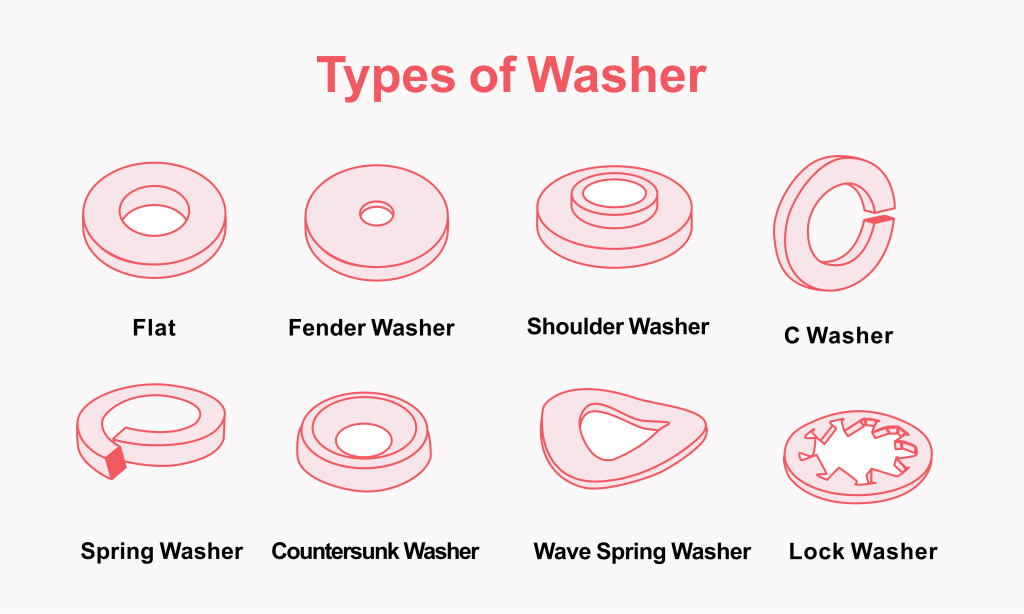
Washers come in many shapes, each designed for a specific mechanical function. Below are the most common types of washers used in engineering and manufacturing.
Plain (Flat) Washers
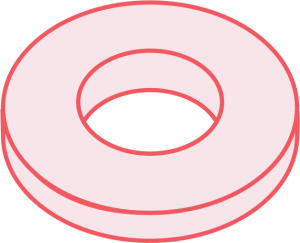
Plain washers are the most widely used type. These standard flat washers are simple flat metal discs with a central hole, designed to spread the fastener’s clamping force across a larger bearing surface. Plain washers also protect the surface beneath the bolt head or nut from scratches and indentation. Standard washers in this category come in SAE and USS sizes to fit common bolt dimensions.
Fender Washers
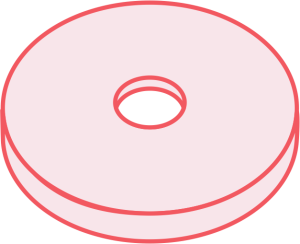
Fender washers feature a small inner hole with a significantly larger outer diameter. This extra-wide surface area distributes load across a much broader zone, making them ideal for fastening thin sheet metal, plastic panels, and soft surfaces where standard flat washers would sink in or pull through.
Fender washers are also effective at covering oversized holes and irregularly shaped openings. Common applications include automotive bodywork, fender panels, drywall installation, and electrical panel mounting.
Shoulder Washers
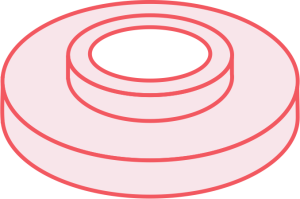
Shoulder washers function as both a washer and a bushing. They consist of a flat disc on top with a cylindrical sleeve (collar) extending downward through the inner hole. The sleeve provides electrical isolation and prevents direct electrical contact between the bolt shank and the hole wall, while the disc provides a seating surface for the fastener.
Shoulder washers are typically made from nylon, PTFE, or other non-conductive plastics. They are common in circuit boards, transformer assemblies, household appliances, and any application requiring electrical isolation between a fastener and a conductive chassis.
C Washers

C washers have a slot cut from one outer edge to the central hole, forming a C shape. This open design allows installation and removal without disassembling the bolted joint. Simply slide the washer in or out from the side.
C washers are useful for maintenance-heavy assemblies where frequent adjustment or washer replacement is needed. They are also used for partial load distribution when full circumferential contact is unnecessary.
Tab Washers
Tab washers have one or more tabs extending from the outer edge. After installation, these tabs are bent against the nut or bolt head, or folded into a slot on the mounting surface. The bent tab physically prevents the fastener from rotating, providing a reliable and permanent anti-loosening mechanism.
Tab washers are common in aerospace, automotive engines, and heavy machinery where vibration is constant and a loosened fastener could be catastrophic.
Square Washers
Square washers have a square outer profile instead of a round one. They provide a larger bearing surface than round washers of equivalent hole size, and their straight edges prevent rotation inside channel struts and slotted mounting systems.
Square washers are frequently used in structural steel connections, Unistrut channel systems, and timber frame construction.
Spring Washers

Spring washers are designed with intentional flex or curvature that creates a spring force against the fastener. This spring action maintains preload and resists loosening under dynamic conditions. Several subtypes of spring washers exist, each with a different mechanism for storing and releasing energy.
Belleville (Conical Spring) Washers
Belleville washers, also known as conical spring washers or disc springs, are cone-shaped and provide the highest spring force per unit of deflection among all spring washer types. These disc springs maintain bolt tension under thermal expansion and contraction, making them valuable in flanged joints, valve assemblies, and high-temperature applications.
Belleville washers can be stacked in series (alternating orientation) for greater deflection, or in parallel (same orientation) for higher load capacity.
Dome Spring Washers
Dome spring washers have a smooth, curved profile that provides consistent spring force. They function as a compact shock absorber, maintaining preload and distributing load evenly. Their rounded surface prevents marking on finished surfaces, making them suitable for applications where surface appearance matters.
Wave Spring Washers

Wave spring washers have a wavy, undulating profile with multiple crests and troughs around the circumference. They provide a lighter, more controlled spring force than Belleville disc springs, making them ideal for low-to-moderate preload applications, bearing retention, and small assemblies with limited axial space.
Note that wave washers generate less spring tension than conical washers and can mark contact surfaces under high loads. They are best suited for controlled preload applications rather than heavy-duty anti-loosening.
Crescent Spring Washers
Crescent washers have two opposing bends that create a crescent-shaped profile. They apply localized spring force and work well for light preload applications. However, crescent washers deflect significantly under heavy loads and are not recommended for high-force joints.
Split Lock Washers
Split lock washers, also called helical spring washers, are the most widely recognized lock washer type. They are a single coil of hardened spring steel with offset ends. When compressed under the fastener head, the helical ends flatten and bite into both the fastener and the surface beneath, creating friction that resists rotational loosening.
However, modern engineering standards increasingly restrict split lock washers to low-torque and light-duty assemblies. Under heavy dynamic loads or high tightening torque, the washer flattens completely (losing its spring action), splits further, or damages the bearing surface. For critical vibration-prone joints, engineers now prefer Nordlock wedge-locking washers, adhesive thread-locking compounds, or prevailing torque locknuts as more reliable alternatives.
Split lock washers remain common in general-purpose mechanical assemblies, automotive components, and construction hardware where loads are moderate and vibration is not severe.
Toothed Lock Washers (External and Internal)

Toothed lock washers are available in external and internal tooth configurations.
External tooth washers have serrated teeth along the outer perimeter that bite into the mating surface under clamping force. Because the teeth act at a larger locking radius from the bolt center, external toothed lock washers generate more resistive torque and provide maximum grip against rotation. They also establish reliable electrical grounding through coated or painted surfaces.
Internal tooth washers have teeth extending inward toward the hole diameter. They bite into small bolt heads or nuts, offering a cleaner aesthetic along the outer edge while preventing fastener rotation. Internal tooth lock washers are preferred when the washer must fit inside a countersunk recess or when only the area directly around the fastener needs locking action.
Countersunk Washers
Countersunk washers (also called finishing washers) have a conical recess designed to accept flat-head or oval head screws. They allow the screw to sit flush with or slightly below the washer surface, providing a clean, finished appearance while spreading clamping force on the material beneath.
These washers are used in cabinetry, furniture, aircraft interior panels, and any assembly where a smooth surface profile is required.
Cup Washers
Cup washers have a dished or cup-shaped profile that surrounds the screw head. They improve pull-through resistance in soft materials like wood and plastic, and they add a decorative, finished look to exposed fastener locations. Cup washers are commonly paired with oval head screws and metal screws in furniture assembly, wood panel fastening, and trim work.
Nordlock Washers
Nordlock washers (wedge-locking washers) use a pair of interlocking wedge-profile discs. The wedge angle is steeper than the thread pitch of the bolt, so any attempt to loosen the fastener forces the two discs apart, increasing clamp load instead of releasing it.
Nordlock washers are among the most reliable anti-loosening solutions for critical joints in mining equipment, wind turbines, bridges, and heavy industrial machinery.
Bonded Sealing Washers
Bonded sealing washers combine a metal outer ring with a bonded rubber or elastomer inner ring. The metal ring provides structural support under clamping force, while the elastomer seals the fastener hole against water, oil, and gas.
These sealing washers are standard in roofing screws, HVAC ductwork, hydraulic fittings, and any outdoor or pressurized application that requires both structural strength and a liquid-tight seal.
What Materials Are Used for Washers?
Washer material determines a component’s strength, corrosion resistance, temperature tolerance, electrical properties, and lifespan. Below is an overview of common materials for metal washers and non-metallic washers, followed by a comparison table.
Metal Washers
Metal washers are the most common category across all types of washers. They provide high strength, durability, and consistent performance under heavy loads.
Stainless Steel
Stainless steel washers (commonly 304 and 316 grades) are corrosion-resistant, durable, and strong. Grade 304 handles most general-purpose applications, while 316 stainless steel performs better in marine, chemical, and high-salt environments. Stainless steel metal washers maintain their properties across a wide temperature range.
Carbon Steel
Carbon steel washers offer high load capacity and are more cost-effective than stainless steel. Low carbon steel washers are suitable for indoor, non-corrosive environments and are often zinc-plated or galvanized for moderate corrosion protection. Medium and high carbon variants provide greater hardness and are used in heavy-duty bolted connections. Carbon steel is also ferromagnetic, making these metal washers appropriate for magnetic applications.
Brass
Brass washers resist corrosion in marine environments and provide good electrical conductivity. They are commonly used in plumbing fixtures, marine hardware, decorative applications like lighting fixtures, and electrical connections.
Copper
Copper washers are soft, highly conductive, and spark-resistant. They are used in gas pipe fittings, fuel system connections, and electrical grounding applications. Copper forms a natural patina (oxidation layer) over time, which can be desirable or undesirable depending on the application. Copper metal washers offer lower mechanical strength compared to steel washers.
Aluminum
Aluminum washers are lightweight, corrosion-resistant, and recyclable. They are widely used in aerospace, automotive assemblies, and consumer electronics. The main limitation is lower wear resistance under dynamic or high-friction conditions compared to steel washers.
Plastic Washers
Plastic washers prevent bolt heads from sinking into soft enclosures, provide electrical isolation, and improve waterproofing by forming a tight seal around the fastener. They are cost-effective to manufacture through injection molding.
Clear plastic (polycarbonate) washers are used in LED fixtures and optical assemblies where light transmission through the washer is needed. Nylon washers are the most common plastic washer type, offering good chemical resistance and moderate strength.
PTFE (Teflon) Washers
PTFE washers are chemically inert and resist nearly all acids, solvents, and reactive chemicals. They provide a non-stick, low-friction surface and withstand temperatures up to approximately 260°C (500°F). PTFE washers are used in chemical processing equipment, food-grade machinery, and pharmaceutical systems.
Rubber Washers
Rubber washers (natural rubber, silicone, neoprene, EPDM) absorb vibrations, dampen noise, and create watertight seals. They compress and conform to surface irregularities, making them effective at sealing joints even on uneven or soft surfaces.
Silicone washers are used in food-processing equipment and medical devices due to their biocompatibility and temperature resistance. Neoprene washers perform well in outdoor and oil-exposure environments.
Ceramic Washers
Ceramic washers handle extreme temperatures and provide excellent electrical insulation. They are lightweight and non-magnetic. However, ceramics are brittle and fail under impact or cyclic loading. Ceramic washers are best suited for static applications like circuit board standoffs, high-temperature furnace components, and specialized sensor assemblies.
Material Comparison Table
| Property | Stainless Steel | Carbon Steel | Brass | Aluminum | Nylon | PTFE |
| Tensile Strength | High | High | Medium | Low-Medium | Low | Low |
| Corrosion Resistance | Excellent | Poor (uncoated) | Good | Good | Excellent | Excellent |
| Max Temperature | ~800°C | ~400°C | ~200°C | ~200°C | ~120°C | ~260°C |
| Electrical Insulation | No | No | No | No | Yes | Yes |
| Weight | Heavy | Heavy | Medium | Light | Light | Light |
| Relative Cost | Medium-High | Low | Medium | Medium | Low | High |
| Best For | General purpose, marine, food | Heavy loads, indoor | Marine, plumbing, electrical | Aerospace, weight-critical | Insulation, light loads | Chemical environments |
What Are Washers Used For?
Different types of washers serve multiple functions within the same assembly. Here are their primary roles.
Load Distribution
A plain washer placed between the bolt head and the substrate distributes clamping force over a larger bearing surface, preventing the fastener from digging into, deforming, or cracking the material. This surface protection is especially important for soft surfaces like wood, plastic, and composite panels.
Spacing and Clearance
Washers fill gaps between components, preventing parts from rubbing against each other. They also stop over-tightening of threaded fasteners. For softer materials, washers prevent metal screws from pulling through or protruding from the opposite side.
Waterproof Sealing
Sealing washers made from rubber, nylon, or bonded metal-rubber composites block water ingress. They form a tight seal between the fastener head and the surface beneath the joint, protecting the hole from moisture. Roofing screws and outdoor enclosures commonly rely on sealing washers.
Corrosion Resistance
Washers act as barriers between dissimilar metals, preventing galvanic corrosion. When a stainless steel bolt is fastened to an aluminum panel, for example, a nylon or PTFE washer between them stops direct electrical contact and slows electrochemical reactions.
Vibration Damping and Locking
Spring washers, lock washers, and rubber washers resist loosening caused by vibration, thermal cycling, and dynamic loads. They maintain spring tension in the joint and reduce the risk of fastener back-off over time.
How to Choose the Right Washer for Your Project
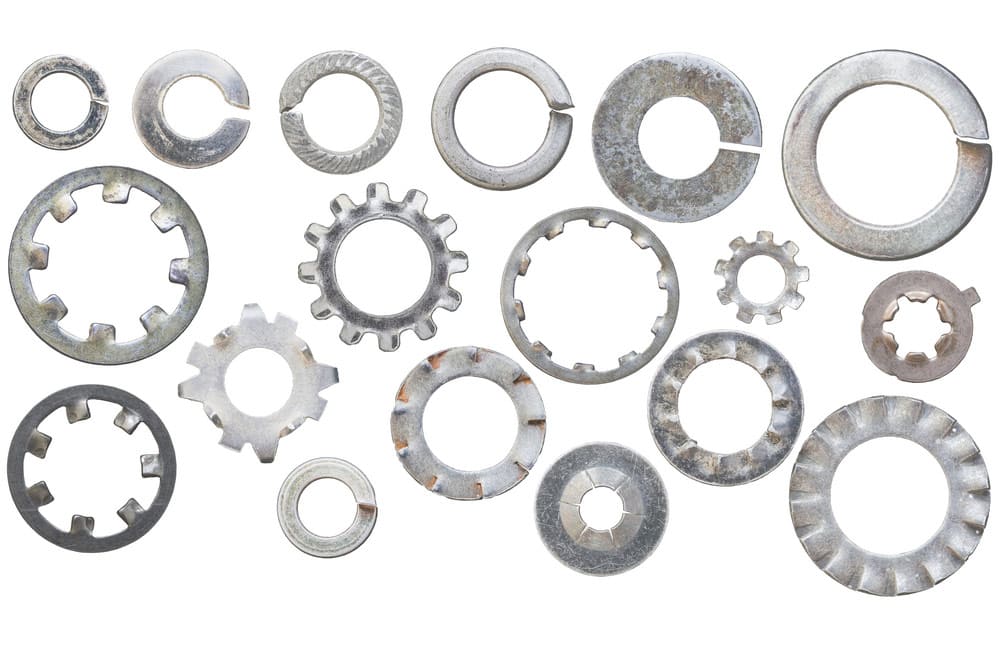
With so many types of washers available, a structured selection process ensures you pick the appropriate washer for each joint.
1. Define the Purpose
Start by identifying the primary function. Is the washer for load distribution, spacing, sealing, vibration damping, locking, or electrical isolation? A single assembly may require different washer types at different joints.
2. Analyze the Load Type and Magnitude
Match the washer type to the load conditions:
- Static axial loads: plain washers or Belleville washers.
- Dynamic and vibrational loads: lock washers, Nordlock washers, or rubber washers.
- Cyclic thermal loads: Belleville disc springs, which compensate for thermal expansion and contraction.
- Shear-dominant loads: thicker washers or shoulder washers that resist lateral movement.
3. Select the Washer Material
Match the washer material to the operating environment:
- Steel washers for heavy-duty, high-strength indoor applications.
- 304/316 stainless for corrosive, marine, or food-grade environments.
- Brass or copper for electrical conductivity and marine exposure.
- Nylon or PTFE for electrical isolation and chemical resistance.
- Rubber for sealing and vibration absorption.
- Ceramic for extreme heat and electrical insulation.
4. Check for Galvanic Compatibility
When the fastener and substrate are dissimilar metals, use a washer material that breaks the galvanic circuit. Nylon, PTFE, and fiber washers are effective isolators that prevent direct metal-to-metal contact between reactive metals.
5. Verify the Size and Fit
Choose a washer with an inner diameter slightly larger than the fastener shank and an outer diameter appropriate for the required bearing area. Check against SAE, USS, or ISO/DIN standard washers for your bolt size.
6. Consider the Operating Environment
Account for temperature range, chemical exposure, moisture, UV exposure, and cleanliness requirements (food-grade, medical-grade). The washer material and finish must withstand the full range of environmental conditions throughout the product’s service life.
Frequently Asked Questions
What is the difference between SAE and USS washers?
SAE washers have a smaller outer diameter and tighter hole tolerance, making them suitable for precision assemblies in automotive and machine applications. USS washers have a larger outer diameter that distributes load over a wider area, making them better for construction, structural, and general-purpose use.
Can I use a washer without a bolt?
Washers are designed to work with fasteners. Without a bolt, screw, or rivet passing through the central hole, the washer has no clamping force and serves no load-distributing purpose. In some cases, plain washers are used as shims or spacers held in place by press-fit or adhesive, but this is not their primary function.
When should I use a lock washer instead of a flat washer?
Use a lock washer when the assembly is subject to vibration, thermal cycling, or dynamic loads that could cause the fastener to loosen over time. For static, low-vibration joints, a standard flat washer is sufficient. In critical applications with severe vibration, consider Nordlock wedge-locking washers or thread-locking compounds for maximum security.
What washer material is best for outdoor use?
Stainless steel (grade 316) is the best general-purpose choice for outdoor applications. It resists rain, humidity, salt spray, and UV exposure without significant degradation. For coastal or marine environments, brass or bronze metal washers are also effective. Avoid plain carbon steel outdoors unless it is heavily galvanized or coated.
Do I need a washer on both sides of a bolted joint?
Placing washers on both sides (under the bolt head and under the nut) provides the most uniform load distribution and protects both contact surfaces. For soft surfaces like wood, plastic, or aluminum sheet, using washers on both sides is strongly recommended. For steel-to-steel joints with hardened fasteners, a washer on the nut side alone is often sufficient.
What is the difference between a spring washer and a lock washer?
Spring washers are a broad category that includes any washer providing elastic spring force (Belleville, wave, dome, crescent types). Their primary function is maintaining preload through spring tension. Lock washers are specifically designed to prevent fastener rotation through friction or mechanical interference (split ring, toothed lock washers, and tab types). Some spring washers also provide locking action, but the mechanisms differ.
How do I choose between different types of washers for sheet metal applications?
For sheet metal work, the key concern is preventing the fastener from crushing or pulling through the thin substrate. Fender washers with their oversized outer diameter are the most common choice. For applications also requiring a watertight seal, bonded sealing washers combine structural support with elastomer sealing. When electrical isolation is needed between the metal screw and the sheet metal panel, use a shoulder washer or nylon flat washer.
